Note: This is an essay I wrote for filmclass at school, so it's a bit different than my other reviews, but I thought it would be interesting to post it here. I did some research and found some old newspapers from the 20's, reviewing the movie. The sources are not available online (except for the New York Times review) and were found on microfilm at my school's library.
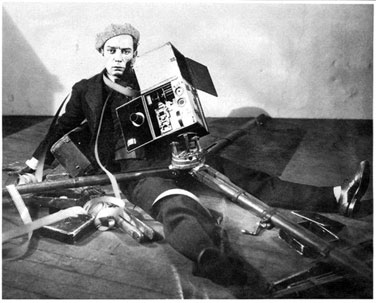
In the movie, Buster plays a photographer who falls in love with a girl. The girl (Sally, played by Marceline Day) works as a secretary at a news desk. In order to impress her and be closer to her, Buster (as he is also called in the movie) buys a movie camera to get a job shooting newsreels. While trying to woo the girl, he finds himself in several funny situations; losing his oversized swimsuit while swimming in the public pool, photographing in the midst of a shootout between Chinese gangsters, and finally rescuing Sally from drowning after a boating mishap.
The movie starts out with a series of scenes focusing on establishing the relationship between Buster and Sally. Variety (09/19/1928) states: “The familiar pattern has been dressed up with some bright gags and several sequences where the laughter comes thick and fast.” The review calls the movie a “good laugh picture” and states that “Production, direction and photography all first rate”. Even at that time, the story was perceived as a “familiar pattern”, which tells us that maybe Keaton and MGM did not want to take a lot of risks creating an original and challenging story, and instead focus on good craftsmanship and funny sequences. The “competing against another wooer in order to get the girl”-plot seems to be a comfortable backdrop to incorporate gags into. The reviewer for Variety also writes that “All in all, it will probably deliver general satisfaction”. In other words, this is not a rave review, although it acknowledges the fact that there are several funny sequences. The review rightfully addresses the lackluster love story that takes up a lot of run-time. Variety remarks: “Apparently some attempt to inject more romance into the yarn than customary in Buster Keaton films. Keaton is a problem on love interest. In the present case, his cow-like adoration of the heroine (Marceline Day) is used to build up sympathy as a counter irritant to his abysmal stupidity in most respects”. One could speculate that this was added to cater for the traditional Hollywood audience.

The New York Herald Tribune (09/18/1927) was a bit more skeptical than Variety:
”Buster Keaton gives a performance brightened only here and there by downright comedy, but they are funny enough, perhaps, to justify going to see him”. It goes on with a somewhat bleak conclusion:
“Needless to say, the picture, relating the adventures of a cameraman in love, is a string of gags. The “frozen faced” hero contributed little new in the way of characterization. Marceline Day, as the telephone girl, considerably decorated the scene, although her acting was negligible. The direction was straight, conservative work, letting its hopes rest in Keaton’s talent as a comic”.
Although the directing is for the most part “straight, conservative work”, there are some inventive sequences. One example of this is the scene where Keaton runs down all the stairs in his building to answer the telephone. A crane shot follows Keaton as he descends the stairs in a long and well rehearsed scene. Also credit should be given to the long take in the dressing room, which is a combination of complex performances and a daringly lengthy take for a commercial movie. To address the other points of the critique, Marceline Day’s acting is a bit anonymous, relying more on her good looks than trying to be inventive or funny and Keaton’s character is really nothing new besides being dumber and more naïve then we are used to.
The New York Times (09/16/1928) is a bit more positive, claiming that it is: “…filled with guffaws and grins, the sort of thing with many original and adroitly worked-out gags. But whether they belong to the story is immaterial”. The review has a point. There are several good and unforgettable comedic sequences in the film including: the long take in the dressing room, the sequence in which Buster imagines himself playing a baseball game at Yankee stadium and, last but not least, the spectacular Chinese tong war sequence where Keaton’s naïve and clumsy character is contrasted with and in the midst of brutes fighting with guns and knives. But there are also some forgettable gags; Buster trying to photograph Sally while fumbling with his camera builds on a cliché and lacks the timing Keaton usually mastered to perfection. The window-breaking gag is also trite and repetitious without being any funnier the second and third time around.
In an article featured in The New York Herald September 18th, 1928 entitled “Buster Keaton on the timing of the laugh”, Buster Keaton told the paper that:
“…the scene where I come into the newsreel office and Harold Goodwin follows and breaks the glass door with his camera was slated for an earlier part of the picture. But it found that the laugh at this point hindered the forward movement of the story which plants the beginning of my romance with Marceline Day. So we had the romance planting all run off first, then worked the glass door gag where the laugh wouldn’t slow up the action of the story”.
The philosophy behind Keaton’s reasoning really explains why the picture failed in this respect; the love story is not interesting or original enough to keep the viewer engaged. And when delaying his gags for the sake of the story, the beginning of the picture gets slow and uninteresting. In the article, Keaton also talks about how he and Edward Sedgewick (the director of the movie) worked out timed intervals for the sequences even before they were filmed, and made a rule that “a good commercial laugh is worth $600”. So if it would cost more, they would probably not do it. Such rigid rules can undermine creativity and seems like rules imposed by MGM, or stems from the responsibility of working for MGM, rather than Keaton’s own.
The Cameraman is ultimately a film with some great comedic sequences bogged down by a trite story and a lot of standardized work. Rudy Blesh, in his book Keaton (1966), sums up my sentiments: A friend of Buster Keaton tells Keaton that the print of The Cameraman is worn out because MGM used it as a “training picture” for future MGM comedians to study. Blesh adds:
“The MGM man spoke with evident pride. But it was equally evident that he was not thinking of Buster Keaton, a man whom MGM had already long since forgotten. He was thinking, MGM story, MGM direction, MGM production. The Machine, not the man. That sounds like the story of Buster Keaton, and so it is. At MGM the real history of The Cameraman is not remembered: the man, Keaton, fighting The Machine, MGM” (302).
Bibliography:
Blesh, Rudi (1966) Keaton. 1st printing. New York, The MacMillian Company
McPherson, Edward (2005) Buster Keaton, Tempest in a flat hat. 1st ed. New York, Newmarket Press
Appendix:
I: The New York Times, 16th September, 1928: Review
II: Variety Magazine, 19th September, 1928: Review
III: The New York Herald Tribune, 18th September, 1928: Review
IV: The New York Herald Tribune, 18th September, 1928: Buster Keaton on the timing of the laugh